Proper feed budgeting is one of the most effective ways to secure herd performance and profitability through the winter months. Whether you’re managing dairy cows, beef cattle or youngstock, knowing how long your feed stocks will last – and how much extra you may need – helps prevent shortages, wasted feed and unnecessary costs.
This guide explains what a feed budget is, why it’s essential for Irish farms and how to calculate it step by step. You’ll also learn how to use our Feed Budget Calculator to check your supplies instantly and plan for a balanced winter feeding strategy.
What is a feed budget?
A feed budget compares the amount of feed you have in store (supply) with the total feed your animals will need (demand) over a set period, usually the housing season. It’s the simplest way to know if you’re heading into winter with enough silage and co-products to meet your herd’s requirements – or if you’ll need to take action now to cover a shortfall.
Why feed budgeting matters
Feed budgeting has always been important, but unpredictable weather and changing feed costs make it more critical than ever. By calculating your feed needs early, you can:
- Avoid running short during housing
- Plan early purchases before prices rise
- Maximise the use of homegrown forage
- Prevent overfeeding or waste
- Protect herd performance through consistent nutrition
Farmers who complete their feed budgets by late summer are better placed to act before winter pressures build.
What you’ll need before you start
To complete your feed budget accurately, gather:
- Stock numbers, broken down by class (milking cows, dry cows, youngstock, beef cattle, sheep, etc.)
- Estimated number of housing days
- Silage pit measurements (length, width and average settled height)
- Number of bales and their average weight
- Silage analysis (DM%)
- Quantities of co-products such as brewers or distillers grains
- An estimate of feed waste (10–15% is typical)
Having this information ready ensures the figures you work out are as reliable as possible.
Step-by-step feed budgeting
1. Measure your feed supply
Start by calculating the total dry matter (DM) available in your pits, bales and any additional feeds.
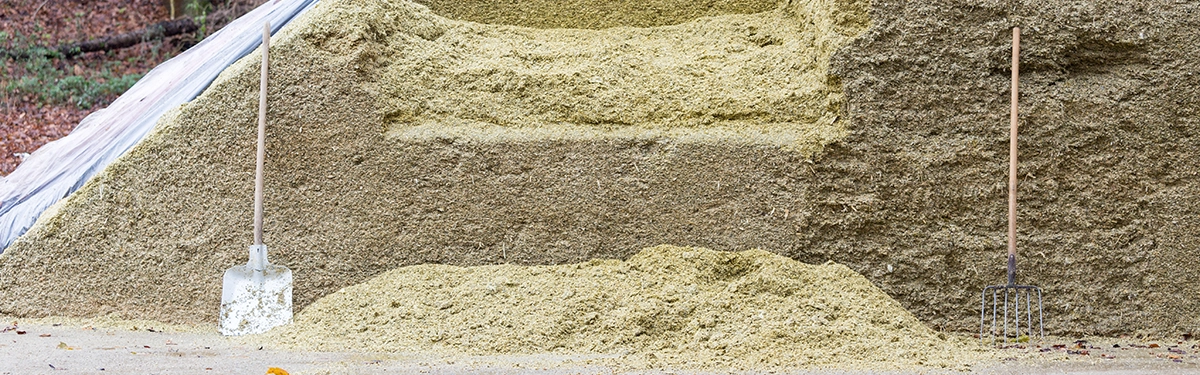
Silage pits
- Measure the length, width and average settled height of each pit in metres.
- Multiply to get the volume (m³).
- Multiply the volume by an average bulk density (240 kg fresh weight per m³ for grass silage).
- Convert to dry matter:
(Volume×240×DM(Volume × 240 × DM%) ÷ 1,000 = tonnes DM(Volume×240×DM
Bales
A typical 700 kg bale at 30% DM contains around 210 kg DM. Adjust for actual weight and DM where possible.
Co-products and other feeds
Use your delivery sheets or supplier data to convert volumes or weights to dry matter. For example, brewers grains average around 20% DM.
Adding up all sources gives you your total feed supply in tonnes of dry matter.
2. Estimate your feed demand
Next, work out how much feed your animals will eat each day and multiply it by the number of feeding days. Typical dry matter intake (DMI) rates are:
- Dairy cows: 11–14 kg DM/day
- Dry cows: 9–10 kg DM/day
- Store cattle: 7–9 kg DM/day
- Sheep: 1.2–1.8 kg DM/day
Then multiply:
(Number of animals ×DMI×days)=totalDMdemand(Number of animals × DMI × days) = total DM demand(Numberofanimals×DMI×days)=totalDMdemand
3. Compare supply with demand
Subtract total demand from total supply to find your surplus or deficit.
- If the number is positive, you have enough feed and possibly a buffer.
- If it’s negative, you’ll need to make up the shortfall.
Even a small deficit can cause issues once waste and unexpected weather are factored in, so always build in a 10–15% safety margin.
You can use the Feed Budget Calculator to make this process quicker and avoid manual errors.
Practical example — dairy herd
Herd: 100 dairy cows
Housing period: 150 days
Average intake: 12 kg DM/day
Feed demand:
100 cows × 12 kg DM × 150 days = 180,000 kg DM (180 tonnes DM)
Feed supply:
- Pit A: 30 m × 10 m × 3 m = 900 m³ × 240 = 216,000 kg × 30% DM = 64.8 t DM
- Pit B: 15 m × 8 m × 2.5 m = 300 m³ × 240 = 72,000 kg × 32% DM = 23.04 t DM
- 400 bales × 210 kg DM = 84 t DM
Total supply: 64.8 + 23.04 + 84 = 171.84 t DM
Deficit: 180 – 171.84 = 8.16 t DM
After adding a 15% buffer, the actual shortfall increases, meaning supplementary feeding or ration adjustments will be needed.
Feed Budgeting Example (Beef & Dairy Combined)
Here’s how a mixed herd feed budget might look:
| Livestock Type | No. Animals | Daily DM per Animal | Housing Days | Total DM Requirement |
| Dairy Cows | 80 | 12 kg | 160 | 153.6 tonnes |
| Youngstock (Beef) | 50 | 8 kg | 160 | 64 tonnes |
| Sheep Flock | 120 | 1.5 kg | 160 | 28.8 tonnes |
| Total | — | — | — | ~246.4 tonnes DM |
If your measured feed supply (pits + bales + co-products) comes up to ~210 tonnes DM, you have a 36-tonne shortfall (plus whatever buffer you build in).
How to manage a feed shortfall
If your feed budget shows a deficit, act early. Options include:
- Source co-products such as brewers grains, distillers grains or maize silage – these can be more cost-effective and sustainable than buying extra bales.
- Stretch existing silage by balancing with high-quality co-products.
- Review group management – prioritise higher-performing stock and adjust feeding rates for others.
- Reduce waste by improving clamp face management and ensuring tight sealing. Even small reductions in feed-out losses can save several tonnes of silage over the winter.
When to complete your feed budget
Feed budgets should be reviewed at least once a year, ideally twice:
- Mid-summer: after first and second cuts when yields are clearer.
- Early autumn: as stock are coming in for housing, to confirm your position before winter.
Recheck if you open new pits, sell or buy stock, or receive updated silage analysis results.
Common feed budgeting mistakes
Avoid these common errors:
- Guessing pit volumes instead of measuring
- Ignoring feed waste or spoilage
- Using fresh weights instead of dry matter
- Forgetting to update numbers when stock change
- Not re-checking silage DM% after analysis
Even experienced farmers can underestimate their feed needs by up to 20% if they skip these steps.
Plan early for peace of mind
Completing your feed budget early gives you the confidence that your herd will be well-fed through winter. Use our Feed Budget Calculator to find out if you have enough feed in store and speak with a Specialist Nutrition advisor for guidance on balancing rations or sourcing sustainable co-products. Start now to secure performance and save costs later.
FAQs on Feed Budgeting
How many bales make up a tonne of silage?
That depends on bale weight and DM. A 700 kg bale at 30% DM contains roughly 0.21 tonnes of dry matter.
When is the best time to do a feed budget?
Mid-summer and early autumn are ideal. You’ll have more accurate figures on silage yields and stock numbers, giving time to act if short.
How can I increase the accuracy of my feed budget?
Test your silage for DM%, weigh a few representative bales, and measure pit dimensions rather than estimating.
What are good co-product options in Ireland?
Brewers grains, maize silage, distillers grains, some dairy by-products — depending on region and availability. Specialist Nutrition can help you source.